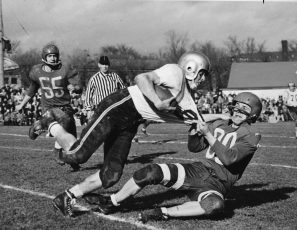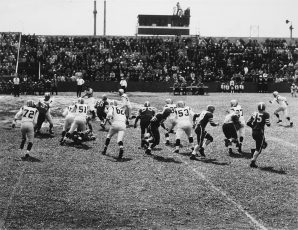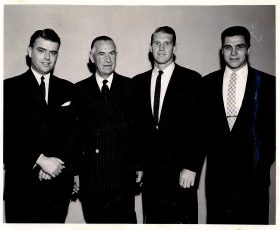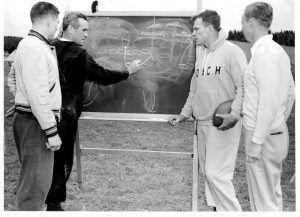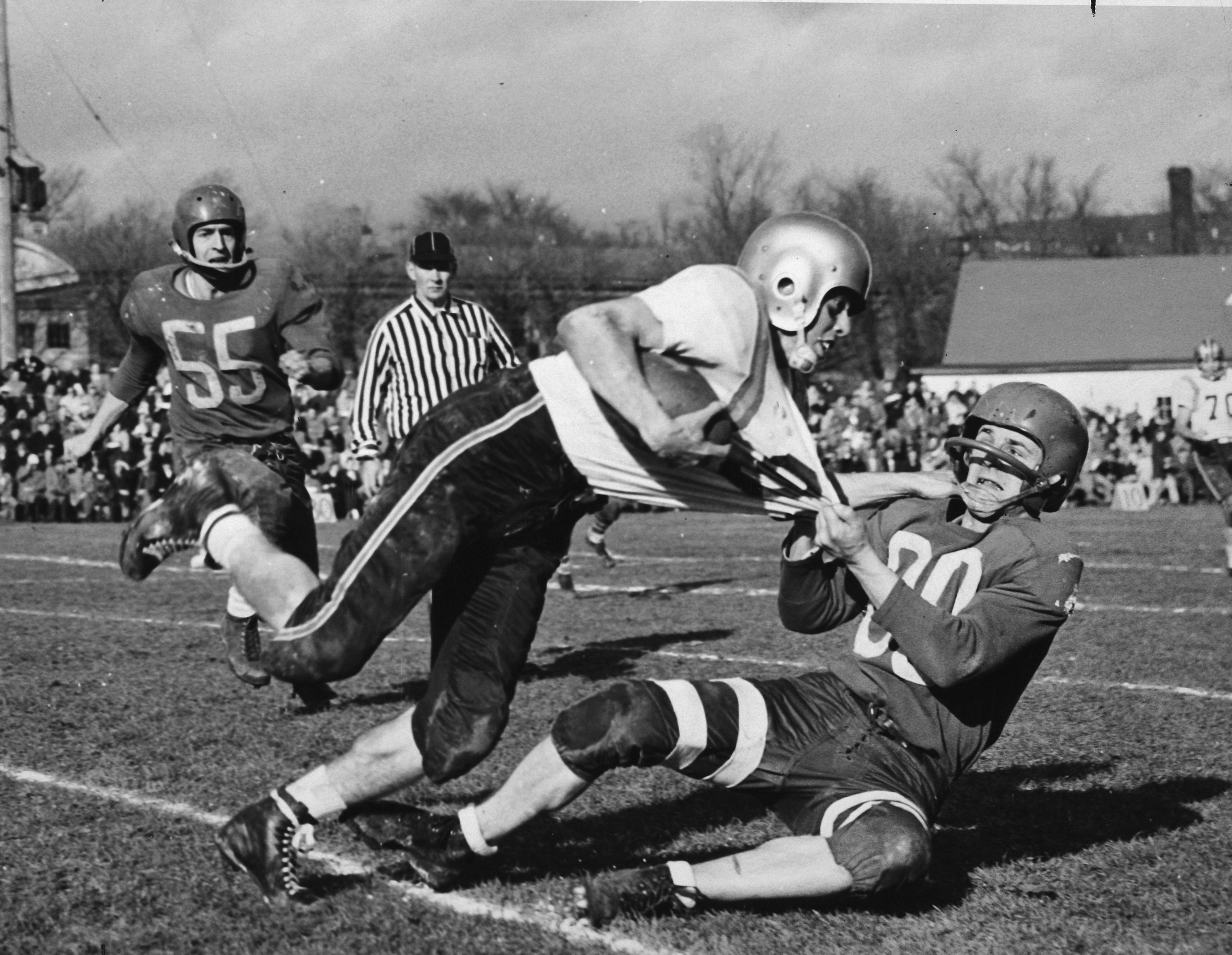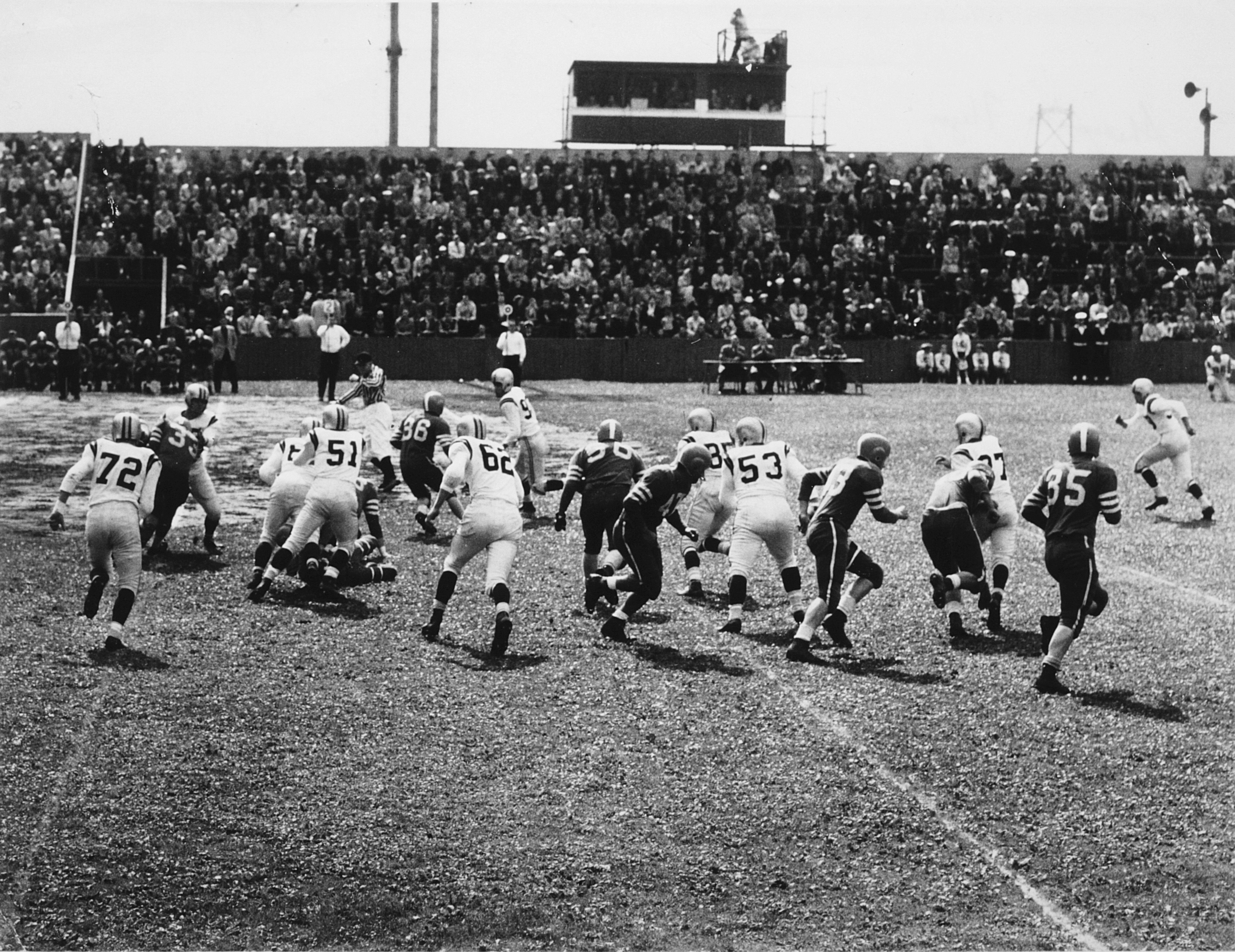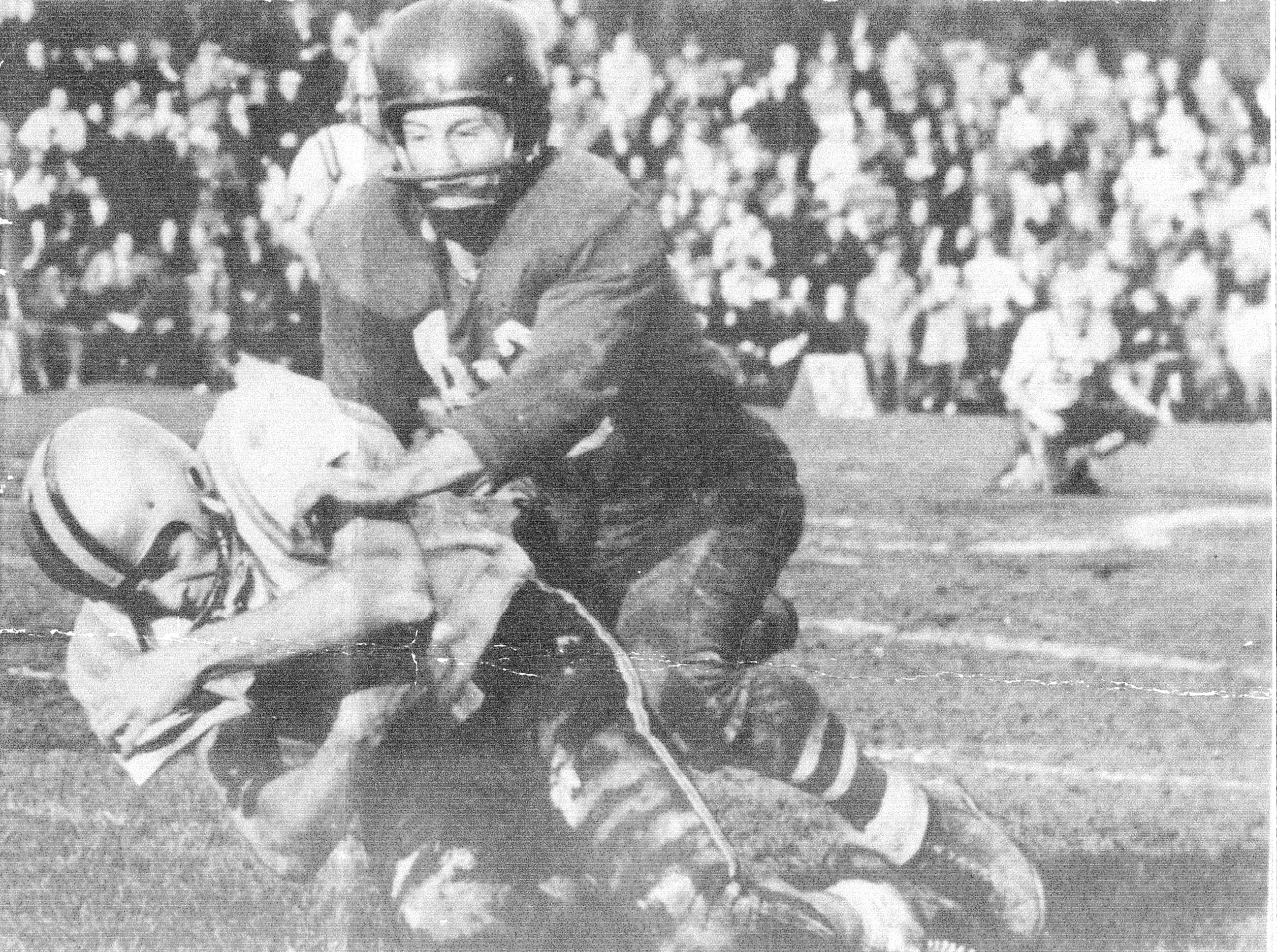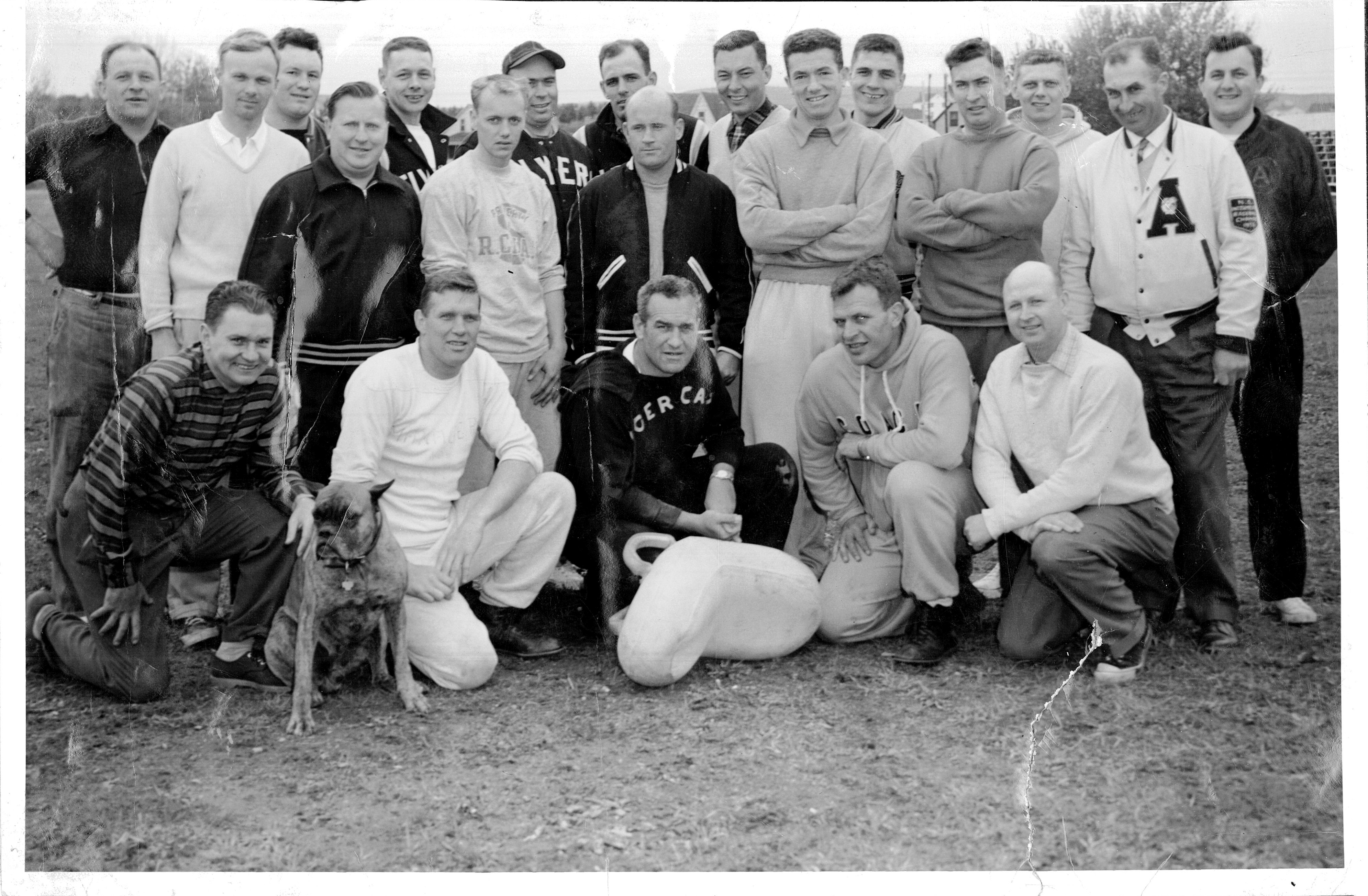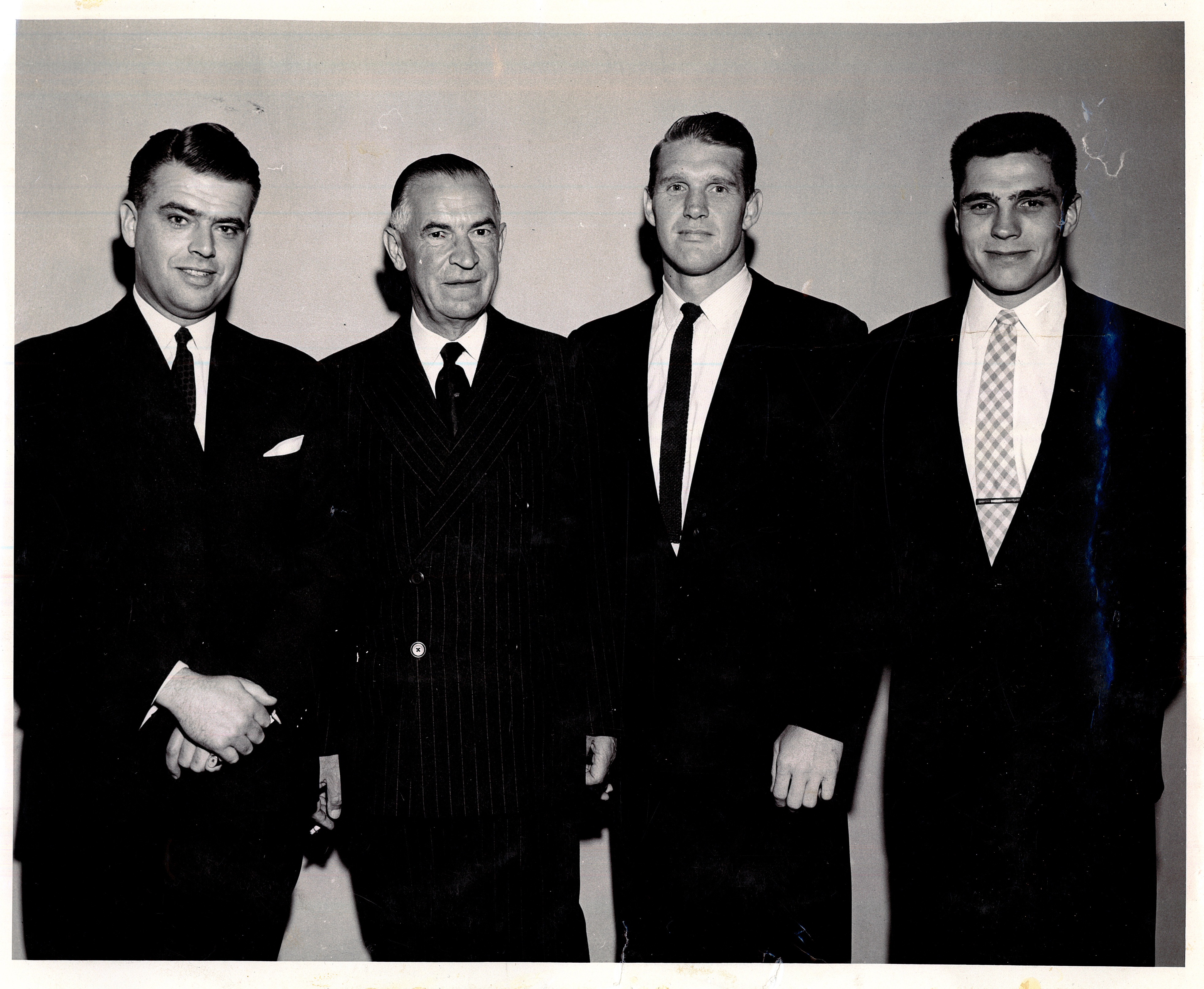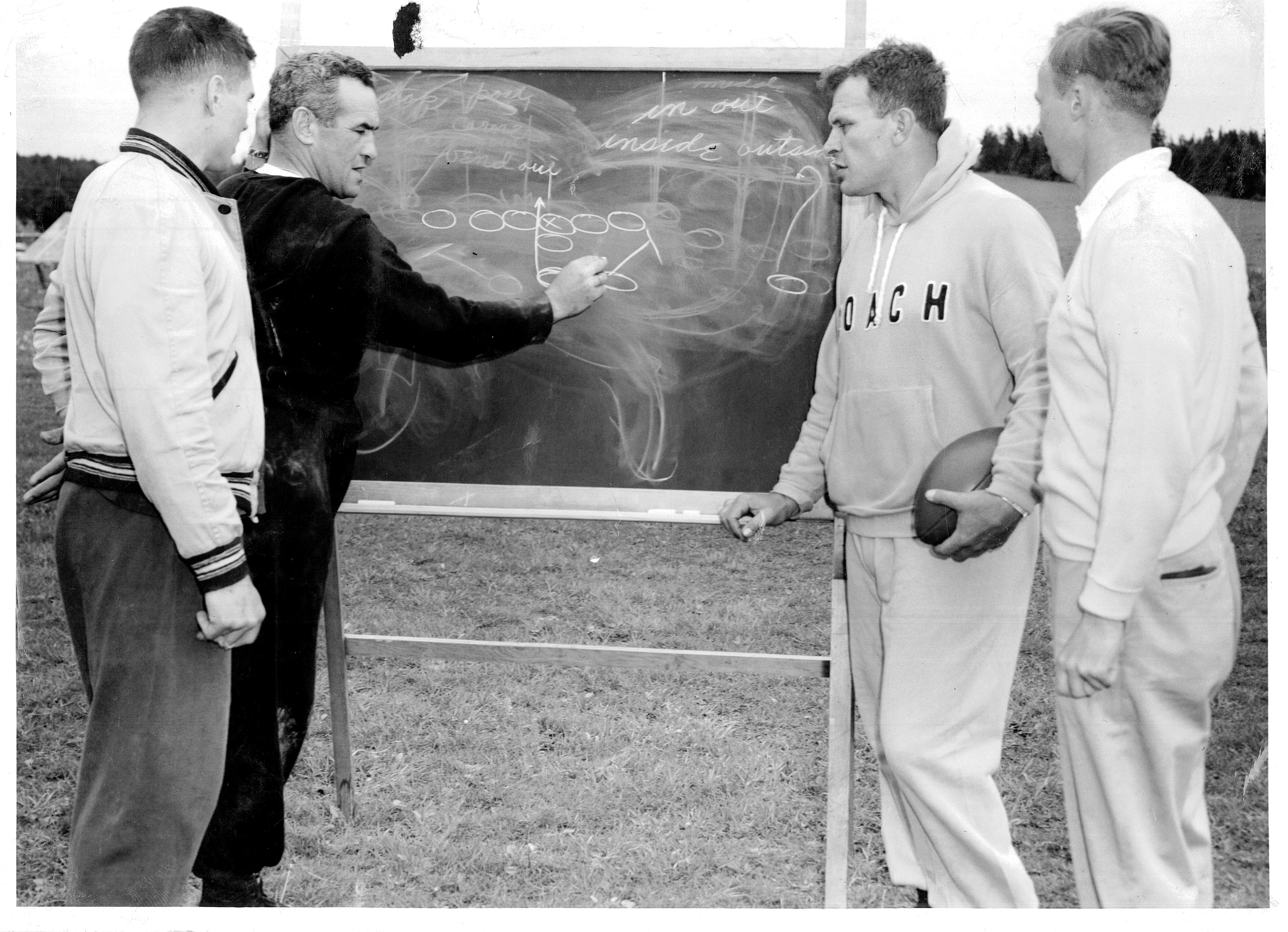
When Harvey “Moose” Mills became head coach of the 1957 Shearwater Flyers, replacing St. Francis Xavier-bound Don Loney, his job appeared cushy. On paper, the defending Purdy Cup champions looked knee-deep in talent as they prepared for another Nova Scotia Football League season. But while the new field boss seemed to be in a rather enviable position, he still had to make some important personnel decisions before the opening game. What he did in those pre-season weeks was put together what was arguably the best football squad ever assembled in this province. And, what talent he had at his disposal! There was quarterback Don Lilley, who had moved over from Stadacona. There were fullbacks Bruce Walker and Bob Hayes, who were gearing to rewrite the record books. There were halfbacks Buck Taylor, Ron Parker and Gordon “Spook” MacLeod. There were offensive linemen like Andy Swan, Dale “The Mount” Klassen, Danny McCowell, L.M. “Torchy” Smith, Alf Nicholson, and Charles Cox. There were defenders Peter “Peaches” Davidson, Ivor “Axe” Axford, Roy “Roxy” Carriere, Doug Grant and “Cabbage” Smith. The club had colourful nicknames, to be sure. But it had
colour, too, on the playing field. It was to be a truly exciting year at the naval air base. From the time the Flyers lifted off the runway in training camp, until they reached their furthest destination, the flight was a masterpiece, one without even the slightest sign of turbulence. By the time the regular season ended, the Flyers had smashed just about every gridiron record this side of the St. Lawrence. The trio that became known as the team’s Three Busy B’s -Bob (Hayes), Bruce (Walker) and Buck (Taylor) – made a shambles of the individual scoring statistics. Ironically, and perhaps fittingly, Hayes and Walker tied for the points championship. Each had an amazing 114 points – with Taylor in third spot with 78. To illustrate the significance of those figures, no one else in the five-team league could muster more than 24 points. The Flyers, as a team, piled up 389 scoring points. Next best was St. F.X. with 115. That sums up the domineering arithmetic that clearly told the story of a powerhouse.
The overpowering numbers the Flyers placed on the scoreboard, however, didn’t end with the league schedule. When Shearwater moved on to face Mount Allison Mounties, the New Brunswick champs, the naval artillery racked up a 40- 18 victory, the club’s ninth straight win of the year. That earned them a Halifax date with the Brantford Tiger-Cats for the Eastern Canada intermediate championship and, while the Ontario-Quebec representatives were unbeaten in 25 games, the awesome Flyers were rated favourites. With 3,300 fans looking on at the Wanderers Grounds, Shearwater lived up to all the press clippings by scoring an electrifying 12-7 verdict, pushing their two-season record to 20-0 and a berth in the national final. In its wake, fans were claiming it was the greatest football game ever played in the Maritime provinces. It was, for certain, the first time a Maritime club had gotten so far and, for its efforts, the Canadian final, against Fort William Redskins, was Halifax-bound. Football fever became an epidemic. It was a storybook finish. A record 5,000 fanatical followers crammed Wanderers and, maybe just to tease the big audience, the Flyers played their way into an unfamiliar zone – behind 21-14. But this was a Hollywood script that wouldn’t be destroyed by any western club. Shearwater simply dug a little deeper and piled up 13 unanswered points and a 27-21 win. Chronicle-Herald football writer George Hanson’s opening paragraph summed up the whole story: “Shearwater Flyers, with a trail of limp opponents and equally limp fans in their wake, today reign as intermediate football kings of Canada.” In the years that followed, Nova Scotia teams would add other national laurels. But it was that 1957 Shearwater powerhouse, more than any other club, that truly brought Canadian football to this part of Canada.
Members of the team: Ivor Axford, Bruce Beacock (trainer), Jack Beck, Al Bice (vice president), Sam Brushett, Roy Carriere, Joe Carver, Al Caulier, Charlie Cox, E.A. Darrach (business manager), Pete Davidson, Gabe DesRoucher, J.M. Dunn (program director), Les Elworthy, Bob Findlay, B.E. Gaynor (managing director), Bill Gourlay (team manager), Paul Gowan, Tom Graham, Doug Grant, Tom Guthrie (equipment manager), Bill Harper, Bob Hayes, H.W. Isaac (president), Eric Keirstead (team physician), Bill Key, Les Keyes, Dale Klassen, W. Kuntz (equipment manager), Don Lilley, Don Loney (scout; analyst), Vern MacDonald, George Mayne, Jim McCombie, Dan McCowell (assistant coach), Pete McGregor, Bill McKinney, Ron McLean, Gord McLeod, Harvey (Moose) Mills (coach), Alf Nicholson, Ron Parker, Malcolm Payne (assistant team manager), John Pike (trainer), R.A. Potts (publicity manager), Bill (Foxy) Reynard, Ed Rieger, John Salmond, N. Semecyzm (equipment manager), John (Cabbage) Smith, Len Smith, Andy Swan, Buck Taylor, R.W. Timbrell (honorary vice president), Bruce Thomas, Bruce Walker, R.P. Welland (honorary president), Ken Whitney.
Bio courtesy of Hugh Townsend
http://www.novamuse.ca/index.php/Detail/objects/9800
http://www.novamuse.ca/index.php/Detail/objects/11348
http://www.novamuse.ca/index.php/Detail/objects/10759
• Millivick TrophyWalker, Hayes
• Halifax Herald Trophy (lineman)Klassen
• NSCFL Coach of the YearMills
• Robinson Memorial Trophy (national), 1957
• Ferguson Memorial Trophy (Eastern Canadian), 1957